
Introduction
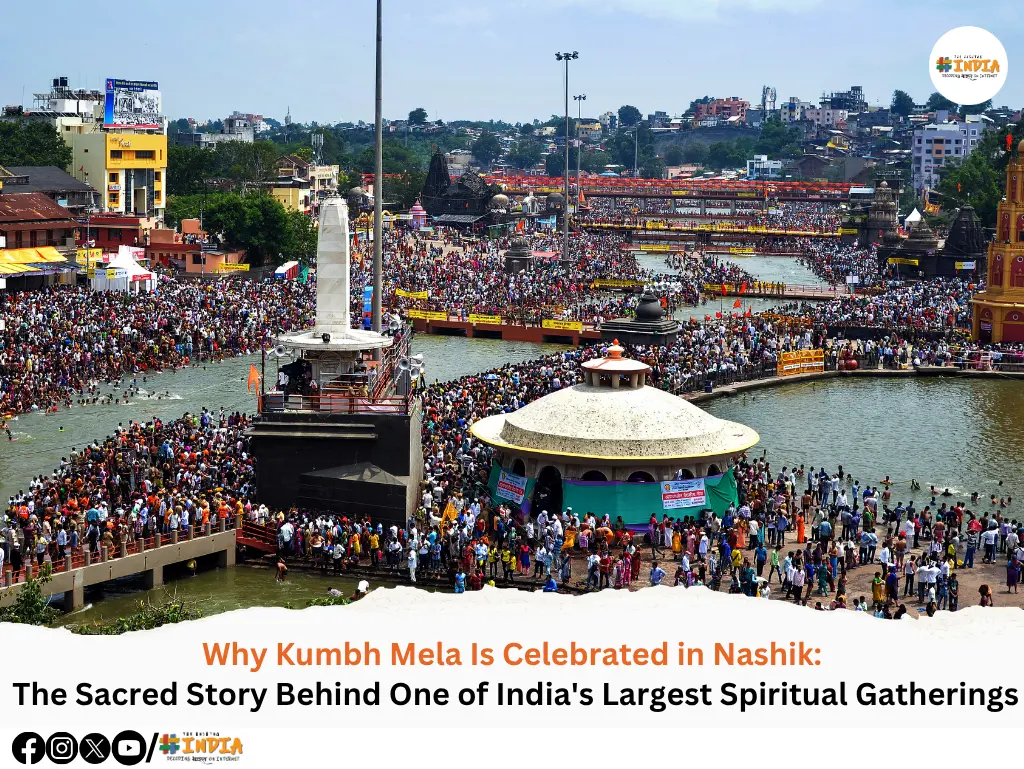
Every twelve years, the city of Nashik in Maharashtra transforms into a sea of devotion as millions of pilgrims, saints, and spiritual seekers gather for one of the world’s largest religious congregations, the Kumbh Mela. The sight of saffron-clad sadhus, chanting devotees, sacred processions, and holy dips in the Godavari River creates an atmosphere unlike any other.
But have you ever wondered why Kumbh Mela is held in Nashik when India has countless holy cities? Why is this city chosen as one of only four locations for the grand festival?
The answer lies in a fascinating blend of Hindu mythology, astronomy, and centuries-old spiritual traditions. From the legendary Samudra Manthan (Churning of the Ocean) to the sacred connection of Lord Rama and the Godavari River, Nashik’s importance goes far beyond geography.
Let’s explore the story behind Nashik’s Kumbh Mela and understand why this ancient city continues to attract millions of devotees from across the globe.
What Is Kumbh Mela?
Kumbh Mela is the largest spiritual gathering in the world, celebrated by Hindus at four sacred locations in India:
- Prayagraj (Allahabad), Uttar Pradesh
- Haridwar, Uttarakhand
- Ujjain, Madhya Pradesh
- Nashik, Maharashtra
The festival follows a cycle based on the movement of Jupiter (Brihaspati), the Sun, and the Moon. Each location hosts the Kumbh Mela when specific planetary alignments occur, making the period spiritually significant according to Hindu astrology.
The word “Kumbh” means pot or pitcher, referring to the mythical pot containing the nectar of immortality (Amrit).
The Mythological Story Behind Kumbh Mela
The origin of Kumbh Mela comes from one of Hindu mythology’s most celebrated stories, the Samudra Manthan, or Churning of the Cosmic Ocean.
According to the legend:
- The Devas (gods) and Asuras (demons) joined forces to churn the ocean in search of Amrit, the nectar of immortality.
- Mount Mandara served as the churning rod, while the serpent Vasuki acted as the rope.
- After immense effort, Lord Dhanvantari emerged carrying the sacred pot of Amrit.
- A fierce battle erupted between the Devas and Asuras over possession of the nectar.
- During the chase that lasted twelve divine days (equivalent to twelve human years), drops of Amrit fell at four earthly locations.
These four places became:
- Prayagraj
- Haridwar
- Ujjain
- Nashik
Because drops of the nectar are believed to have fallen here, these cities are regarded as exceptionally sacred.
Why Did the Nectar Fall in Nashik?
Nashik’s association with Kumbh Mela comes from the belief that drops of Amrit fell near Trimbakeshwar and along the Godavari River during the celestial battle.
This divine event transformed the region into one of Hinduism’s holiest pilgrimage destinations.
Unlike the other three cities, Nashik’s Kumbh has a unique connection with both:
- Trimbakeshwar
- Ramkund in Nashik city
Both places become important centers for ritual bathing and religious ceremonies during the festival.
The Importance of Trimbakeshwar
Located around 30 kilometers from Nashik city, Trimbakeshwar is among the twelve sacred Jyotirlingas dedicated to Lord Shiva.
It is one of India’s most revered pilgrimage sites because:
- It houses one of the twelve Jyotirlingas.
- The Godavari River originates near Trimbakeshwar.
- Ancient sages performed penance here.
- Numerous Vedic rituals continue to be practiced even today.
During Kumbh Mela, Trimbakeshwar hosts many of the major rituals and royal processions of saints.
Why Is the Godavari River So Sacred?
The Godavari is often called the “Ganga of the South.”
According to Hindu beliefs:
- Sage Gautama performed intense penance to bring the holy Ganga to this region.
- Lord Shiva granted his wish.
- The river emerged at Trimbakeshwar and became the Godavari.
Since the river is believed to possess the same spiritual purity as the Ganges, taking a holy dip during Kumbh Mela is considered especially auspicious.
Pilgrims believe the sacred bath helps cleanse sins and supports spiritual growth.
The Connection Between Nashik and Lord Rama
Nashik is also deeply connected with the epic Ramayana.
According to tradition:
- Lord Rama
- Goddess Sita
- Lord Lakshmana
spent a significant part of their exile in Panchavati, located in present-day Nashik.
Several important events from the Ramayana took place here, including:
- The arrival of Surpanakha
- Lakshmana cutting off Surpanakha’s nose
- The abduction of Sita by Ravana
Interestingly, many believe the name “Nashik” comes from the Sanskrit word “Nasika”, meaning nose, referring to the episode involving Surpanakha.
This association further strengthens Nashik’s spiritual significance.
Why Is the Holy Dip So Important?
The most significant ritual of Kumbh Mela is the Shahi Snan (Royal Bath).
During this ceremony:
- Akharas of saints march in grand processions.
- Naga Sadhus take the first holy dip.
- Millions of pilgrims follow.
- Sacred chants and rituals fill the riverbanks.
Devotees believe bathing in the Godavari during these astrologically significant moments brings:
- Spiritual purification
- Inner peace
- Liberation from past sins
- Blessings for future generations
What Makes Nashik Kumbh Different?
Although all four Kumbh Melas share the same origin story, Nashik has several unique features.
Dual Sacred Locations
Religious activities take place at both:
- Trimbakeshwar
- Ramkund in Nashik
Strong Shaivite Tradition
Because of the Trimbakeshwar Jyotirlinga, Nashik has a deep connection with Lord Shiva.
Godavari River
Unlike Prayagraj, which is known for the Triveni Sangam, Nashik’s rituals center around the sacred Godavari.
Ramayana Heritage
Few Kumbh locations have such a strong connection with Lord Rama’s life.
Astronomical Significance
Kumbh Mela is not celebrated on fixed calendar dates.
The festival depends on specific planetary positions.
For Nashik, Kumbh Mela is held when:
- Jupiter enters the zodiac sign Leo (Simha Rashi).
- Certain alignments with the Sun and Moon create an especially auspicious period.
Because of this, the Nashik Kumbh is also known as Simhastha Kumbh Mela.
This combination occurs approximately once every twelve years.
Cultural Importance of Nashik Kumbh
Beyond religion, the Kumbh Mela is a celebration of India’s living heritage.
Visitors experience:
- Ancient Vedic rituals
- Spiritual discourses
- Traditional music
- Cultural performances
- Religious debates
- Yoga and meditation camps
- Pilgrim traditions that have continued for centuries
It is also a major opportunity for scholars, photographers, historians, and travelers to witness India’s rich cultural diversity.
Economic Impact on Nashik
The Kumbh Mela also brings significant economic benefits to the region.
Millions of visitors support:
- Hotels and homestays
- Local restaurants
- Transport services
- Small businesses
- Handicraft markets
- Religious tourism
- Local employment
The festival boosts Nashik’s economy while showcasing Maharashtra’s cultural heritage to visitors from India and around the world.
Interesting Facts About Nashik Kumbh Mela
- Kumbh Mela is recognized as one of the largest peaceful human gatherings in the world.
- Nashik and Trimbakeshwar jointly host the festival.
- The Godavari River is revered as the “Ganga of the South.”
- Trimbakeshwar is one of the twelve Jyotirlingas of Lord Shiva.
- The name Nashik is believed to be derived from the Ramayana episode involving Surpanakha.
- The festival follows a twelve-year astronomical cycle based on Jupiter’s movement.
- Millions of devotees, saints, and tourists attend every Kumbh Mela.
Final Thoughts
Kumbh Mela in Nashik is far more than a religious festival, it is a remarkable convergence of mythology, faith, astronomy, history, and culture. Rooted in the legend of the Amrit Kalash, strengthened by the sanctity of the Godavari River and Trimbakeshwar Jyotirlinga, and enriched by its deep connection to the Ramayana, Nashik holds a unique place among India’s holiest pilgrimage destinations.
For millions, the Kumbh Mela is not just about taking a sacred dip in the river. It is an opportunity for spiritual reflection, community, and renewal, a tradition that has endured for centuries and continues to inspire generations.
Whether you visit as a devotee, a traveler, or someone curious about India’s cultural heritage, witnessing the Kumbh Mela in Nashik offers an unforgettable glimpse into one of humanity’s oldest and most enduring spiritual traditions.
FAQs
Kumbh Mela is celebrated in Nashik because Hindu mythology says that drops of the Amrit (nectar of immortality) fell here during the Samudra Manthan (Churning of the Ocean). This made Nashik one of the four sacred sites where the Kumbh Mela is held.
The Godavari River is considered the “Ganga of the South.” Devotees believe that taking a holy dip in its waters during Kumbh Mela cleanses sins, brings spiritual purification, and earns divine blessings.
The festival is known as Simhastha Kumbh because it is held when Jupiter (Brihaspati) enters the zodiac sign Leo (Simha Rashi), creating an auspicious planetary alignment according to Hindu astrology.
Trimbakeshwar is home to one of the 12 Jyotirlingas of Lord Shiva and is the origin of the Godavari River. It is one of the main venues for the Nashik Kumbh Mela and holds immense religious importance.
The Nashik Kumbh Mela is held once every 12 years, based on specific astronomical alignments involving Jupiter, the Sun, and the Moon, making it one of India’s most significant spiritual events.
Stay Connected with The Hashtag India!
Love what you just read? Just Stay curious, keep exploring, and let every story inspire your day, your passions, and your journey!
Follow us for more amazing content: