
As the monsoon begins to withdraw and India enters its festive months, the country takes on a familiar rhythm. Homes are decorated, temples glow with lamps, markets fill with colour, and communities come together through prayer, music, food and celebration.
Among the most widely observed festivals during this period is Navratri, nine nights dedicated to the worship of Shakti, the divine feminine power.
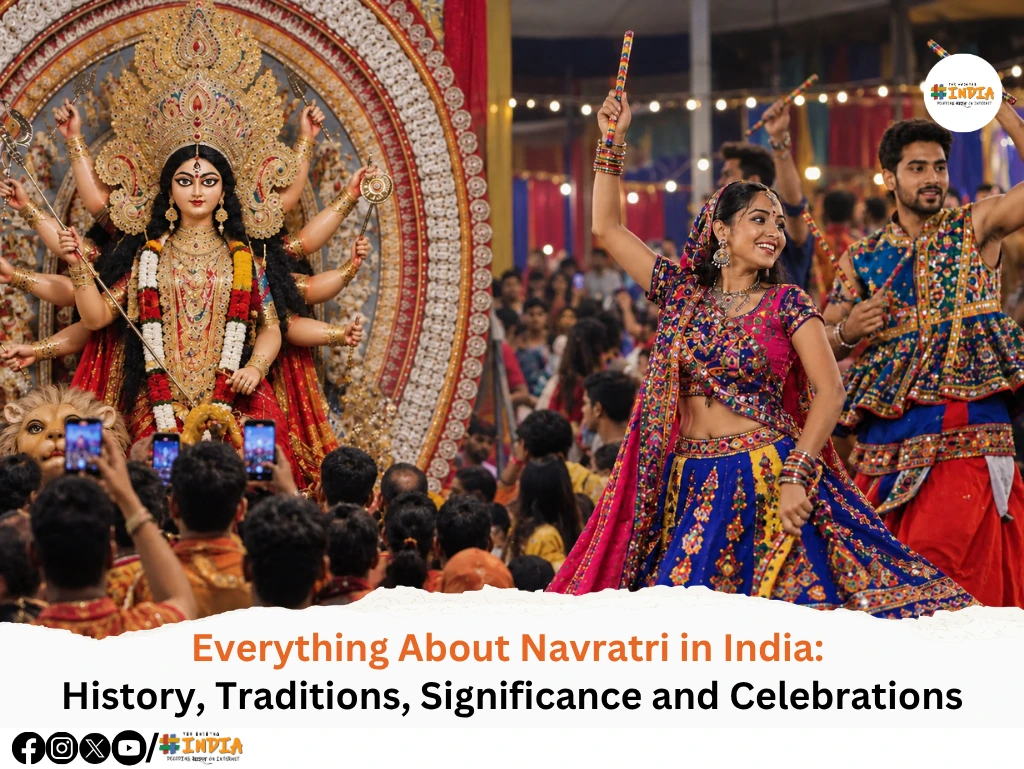
Celebrated across India, Navratri takes many forms. Gujarat comes alive with Garba and Dandiya, West Bengal celebrates Durga Puja through elaborate pandals and artistic traditions, North India observes fasting, Kanya Puja and Ramlila, while South India brings its own expressions through Golu, Mysuru Dasara, Ayudha Puja and Vidyarambham.
The rituals may differ, but the festival carries a common thread of devotion, strength, renewal and community.
From its mythology and the nine forms of Goddess Durga to regional traditions, food, fasting, dance and its relevance in contemporary India, Navratri offers a fascinating view of how India’s traditions continue to evolve while retaining their cultural roots.
What Is Navratri?
The word Navratri comes from the Sanskrit words nava, meaning nine, and ratri, meaning night.
Several Navratris are observed during the Hindu calendar, but Sharad Navratri, generally observed during September or October, is among the most widely celebrated.
The festival traditionally extends across nine nights and ten days. The nine nights are associated with the worship of the Navadurga, nine forms of Goddess Durga, before the celebrations culminate in Vijayadashami.
Each form of the Goddess represents different qualities and aspects of Shakti. Together, they present feminine power not as a single characteristic, but as a combination of creation, courage, discipline, nurturing, protection and transformation.
This makes Navratri both a religious observance and a cultural journey through different ideas of strength.
The Story Behind Navratri
One of the central stories associated with Navratri is the battle between Goddess Durga and Mahishasura.
According to Hindu tradition, Mahishasura was a powerful asura who received a boon that made him extremely difficult to defeat. His growing power disrupted the established order and challenged the gods.
The divine energies of the gods came together, giving rise to Goddess Durga.
Armed with divine weapons and depicted riding a lion or tiger, Durga fought Mahishasura and ultimately defeated him.
Her victory represents the triumph of dharma over destructive forces and the restoration of balance.
The story has endured for centuries because its symbolism extends beyond the battle itself. Mahishasura can represent unchecked power and disorder, while Durga represents the strength required to confront and overcome forces that threaten balance.
At its core, the story carries a simple idea: strength becomes meaningful when it is guided by purpose.
Why Are There Nine Nights?
The nine nights of Navratri are traditionally dedicated to the nine forms of Durga, collectively known as the Navadurga.
These forms are:
Shailaputri, Brahmacharini, Chandraghanta, Kushmanda, Skandamata, Katyayani, Kalaratri, Mahagauri and Siddhidatri.
Each has its own mythology, imagery and symbolism.
The journey begins with Shailaputri, associated with the mountains and the idea of stability and groundedness. It moves into Brahmacharini, representing devotion, discipline and perseverance.
Chandraghanta brings courage and readiness to face challenges, while Kushmanda represents creation and cosmic energy.
With Skandamata, nurturing becomes an expression of strength. Katyayani represents determination and the courage to act, while Kalaratri symbolises the ability to confront darkness, fear and ignorance.
The journey then moves towards Mahagauri, associated with purity, peace and renewal, and finally Siddhidatri, representing accomplishment and fulfilment.
Together, the nine forms create a broader understanding of Shakti, strength that can create, nurture, protect, confront, transform and renew.
Vijayadashami: The Culmination of Navratri
Navratri concludes with Vijayadashami, also known as Dussehra.
The significance of the day varies across regions. In communities celebrating Durga Puja, it marks Goddess Durga’s victory over Mahishasura. In many parts of North India, Dussehra commemorates Lord Rama’s victory over Ravana, accompanied by Ramlila performances and Ravana effigy burnings.
Although the stories differ, both traditions centre around ideas of victory, restoration and the triumph of dharma.
Vijayadashami therefore serves not only as the end of the festive period, but also as a symbolic transition towards renewal and a new beginning
Navratri Across India
One of the most remarkable aspects of Navratri is the way a shared festival takes on different cultural identities across the country.
From dance and music to devotional rituals, art and food, every region adds its own expression.
Gujarat: Garba and Dandiya
In Gujarat, Navratri is closely associated with Garba and Dandiya-Raas.
Garba is traditionally performed in a circle around a lamp or symbolic representation of the divine feminine. The circular movement carries both cultural and devotional significance, while the collective rhythm brings people together.
Dandiya-Raas adds another layer through coordinated movements with decorated sticks.
Over time, these traditions have travelled far beyond Gujarat and are now celebrated across Indian cities and by communities around the world.
What remains at the centre is the combination of music, movement, devotion and community.
Maharashtra: Family Traditions and Community Celebrations
In Maharashtra, Navratri often begins with Ghatasthapana, accompanied by prayers and devotional rituals in homes and temples.
Alongside traditional observances, Garba and Dandiya events have become popular across cities and communities.
For many families, Navratri is also a time when traditions are passed from one generation to another, creating a connection between inherited practices and contemporary celebrations.
West Bengal: Durga Puja
In West Bengal, Navratri takes the spectacular form of Durga Puja.
Large pandals, intricately crafted idols, lighting, music, food and community gatherings transform neighbourhoods into temporary cultural spaces.
The central narrative remains Durga’s victory over Mahishasura, but the celebration has also become an important expression of art, craftsmanship and community identity.
For many people, Durga Puja is simultaneously a spiritual experience and a celebration of Bengal’s cultural creativity.
North India: Fasting, Kanya Puja and Ramlila
Across many parts of North India, Navratri is observed through fasting, prayers and temple visits.
Kanya Puja, also known as Kanjak in some regions, honours young girls as symbolic manifestations of the Goddess.
The festive period also leads into Ramlila, where the story of Lord Rama is performed through theatre and public performances. Dussehra celebrations often culminate in the burning of Ravana effigies.
Here, devotion comes together with storytelling, performance and community participation.
South India: Golu, Dasara and Vidyarambham
In parts of South India, Navratri is celebrated through distinctive traditions such as Golu or Kolu.
Families arrange dolls and figurines on stepped platforms, often depicting deities, mythological narratives, cultural scenes and everyday life.
Golu serves as more than a decorative tradition. It becomes a way of preserving stories and cultural memory within families.
Karnataka’s Mysuru Dasara offers another grand expression of the festive season, while Ayudha Puja honours books, tools, vehicles, instruments and objects associated with work and learning.
In Kerala, Vidyarambham connects the festival with a child’s introduction to education.
Together, these traditions highlight the connection between knowledge, work, creativity and devotion.
Telangana: Bathukamma
Telangana brings another distinctive cultural expression through Bathukamma, a floral festival closely associated with women, seasonal flowers, music and community gatherings.
Women arrange flowers into colourful formations and gather to sing and celebrate together.
The tradition reflects a close relationship between community, nature and seasonal abundance, adding another dimension to the wider festive period.
Navratri, Fasting and Food
Fasting is an important part of Navratri for many devotees, although practices vary considerably across families and regions.
Depending on individual traditions, people may consume fruits, milk, nuts, dairy products, sabudana, singhara, kuttu, rajgira or samak rice while avoiding certain grains and ingredients.
It is important, however, not to treat every fasting practice as automatically healthy or describe Navratri fasting as a guaranteed detox.
The nutritional impact depends on what is consumed, how it is prepared, portion sizes, hydration and individual dietary needs.
For people with specific health conditions or those taking certain medications, fasting may require guidance from a qualified healthcare professional.
Beyond health claims, fasting has a deeper traditional purpose. For many devotees, it represents discipline, restraint, devotion and mindful consumption.
Garba, Movement and Community
The physical energy of Navratri is most visible through dance.
Garba involves repeated steps, turns and coordinated movements, sometimes continuing for extended periods. Like other forms of dance, it can contribute to physical activity, coordination and cardiovascular movement.
But reducing Garba to exercise misses its cultural purpose.
People dance because they are celebrating.
Music creates rhythm, the group creates energy, and participation turns movement into a shared experience.
The same sense of togetherness extends across Navratri celebrations. People pray together, cook together, decorate spaces, organise events, perform rituals and visit family and friends.
In this way, Navratri creates opportunities for collective participation and cultural connection.
Navratri, Fasting, Food and Colours
Food is an important part of Navratri, while fasting adds a dimension of discipline, devotion and restraint. Practices vary across families and regions, with devotees following different forms of fasting according to tradition.
Common Navratri preparations use ingredients such as sabudana, kuttu, singhara, rajgira and samak rice, along with fruits, dairy and nuts. Recipes differ from one region and household to another, adding to the festival’s culinary diversity.
Fasting food is not automatically healthier, however. Preparation methods, portions, hydration and individual dietary needs still matter. Those with specific health conditions or taking certain medications may need professional guidance before fasting.
Navratri also has a distinctive visual identity. Many communities associate different colours with each day, although the sequence varies across regions and calendar years. These colours appear in clothing, decorations, temples and public celebrations, creating a changing visual character throughout the nine nights.
Together, food, fasting and colours add to the sensory and cultural experience of Navratri.
Garba, Movement and Community
Navratri comes alive through movement, particularly through Garba and Dandiya.
Garba involves rhythmic steps, circular formations and coordinated movement. While it naturally provides physical activity, its significance goes beyond exercise. It is a social and cultural tradition built around music, participation and celebration.
People dance together, organise community events, visit one another and participate in shared rituals. This collective experience is an important part of what makes Navratri feel larger than an individual religious observance.
The circle of Garba itself reflects this sense of togetherness, everyone participates in the same rhythm, while individual movements become part of a shared celebration.
From traditional community gatherings to large modern events, Garba demonstrates how an old cultural practice continues to find space in contemporary India.
Understanding Shakti
At the heart of Navratri is Shakti — divine feminine power.
The Goddess appears in many forms throughout the festival. She creates, nurtures, protects, confronts and transforms. Her strength is therefore not limited to physical power; it also includes courage, discipline, wisdom, resilience and compassion.
This broader understanding of strength is one reason the symbolism of Navratri continues to resonate across generations.
Strength can mean having the courage to act.
It can mean staying disciplined when progress is slow.
It can mean creating something new, caring for others or finding the resilience to begin again.
Navratri brings these different dimensions together through its stories and traditions.
Shakti and the Contemporary Meaning of Strength
The celebration of feminine power also invites a wider conversation about the position of women in contemporary society.
Indian traditions have represented women through powerful forms of the Goddess for centuries. At the same time, the idea of Shakti can encourage reflection on everyday forms of strength, education, independence, leadership, safety, representation and freedom of choice.
The religious symbolism and modern social realities are not identical, but the festival creates space to think about how strength and agency are understood beyond mythology.
In this sense, celebrating Shakti can also mean recognising the many ways women contribute to families, communities, workplaces and society.
Navratri and Modern Aspirations
Traditions remain relevant when every generation can find meaning in them.
The nine forms of Durga can be viewed within their religious context while also offering broader reflections on contemporary life.
Shailaputri represents strong foundations.
Brahmacharini reflects discipline and perseverance.
Chandraghanta brings courage into focus.
Kushmanda represents creativity and creation.
Skandamata reflects nurturing strength.
Katyayani represents determination and action.
Kalaratri reminds us to confront difficult realities.
Mahagauri represents renewal.
Siddhidatri reflects fulfilment.
These interpretations do not replace the traditional meaning of the Navadurga. Instead, they show how ancient symbolism can continue to speak to modern aspirations.
For a student, strength may mean discipline. For an entrepreneur, it may mean determination. For an artist, it may mean creativity. For a parent, it may mean nurturing and responsibility.
The stories remain ancient, but the questions people bring to them continue to evolve.
Final Thoughts
Navratri is more than nine nights of celebration. It brings together mythology, faith, art, food, music, movement and community in countless regional forms across India.
At its heart is Shakti, a powerful idea of creation, protection, courage and transformation.
From the Garba grounds of Gujarat and Durga Puja pandals of West Bengal to Golu displays in South India and family rituals across the country, Navratri shows how one festival can take many forms while retaining its cultural essence.
Its stories may be ancient, but their interpretation continues to evolve with every generation.
That is the enduring spirit of Navratri: a tradition rooted in the past, experienced in the present and carried forward into the future.
FAQs
Navratri is a nine-night festival dedicated to Shakti and the worship of Goddess Durga. It represents devotion, strength, renewal and the triumph of dharma.
The nine forms of Durga, known as the Navadurga, are Shailaputri, Brahmacharini, Chandraghanta, Kushmanda, Skandamata, Katyayani, Kalaratri, Mahagauri and Siddhidatri.
Sharad Navratri 2026 begins on 11 October and ends with Vijayadashami on 20 October 2026.
Celebrations vary by region, Garba and Dandiya in Gujarat, Durga Puja in West Bengal, fasting and Ramlila in North India, and Golu, Mysuru Dasara and Ayudha Puja in South India.
Fasting represents devotion and discipline, while Garba brings together music, movement and community celebration.
Stay Connected with The Hashtag India!
Love what you just read? Just Stay curious, keep exploring, and let every story inspire your day, your passions, and your journey!
Follow us for more amazing content: