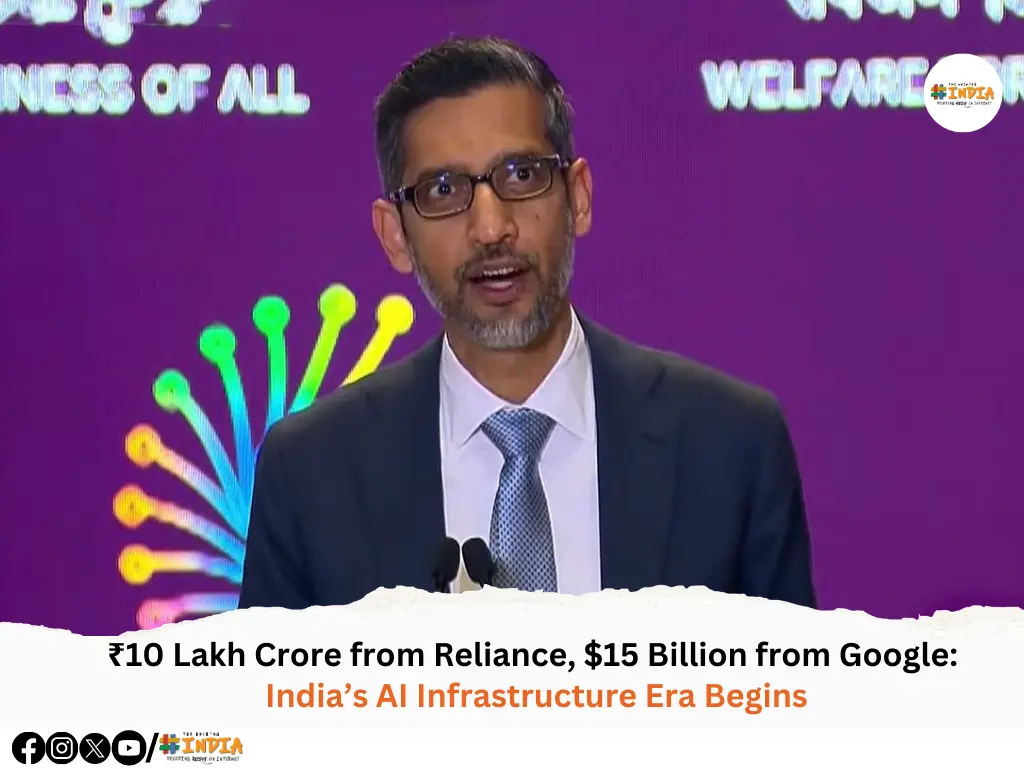

India’s artificial intelligence ambitions reached a defining moment at the India AI Impact Summit 2026. In a powerful convergence of domestic scale and global confidence, two industry leaders, Mukesh Ambani and Sundar Pichai, unveiled infrastructure commitments that could reshape not only India’s technology landscape, but also its long-term economic trajectory.
At the heart of these announcements lies a defining shift: India is building its own AI backbone.
Reliance’s ₹10 Lakh Crore Commitment to AI
Chairman of Reliance Industries, Mukesh Ambani announced that Reliance, together with Jio Platforms, will invest ₹10 lakh crore in artificial intelligence over the next seven years.
This is not merely a financial commitment, it is a strategic blueprint to establish sovereign AI capabilities at scale.
Ambani outlined three foundational pillars under what he described as “Jio Intelligence”:
1. Gigawatt-Scale AI Data Centres
Construction is already underway on multi-gigawatt AI-ready data centres in Jamnagar. Over 120 megawatts of capacity are expected to come online in the second half of 2026, marking the first step toward full gigawatt-scale compute infrastructure.
In today’s AI economy, compute power has become the defining competitive advantage. Ambani emphasized that the real constraint in AI is not talent or imagination, it is the scarcity and high cost of compute. This investment directly addresses that gap.
2. Green Energy Advantage
The expansion will be supported by up to 10 gigawatts of ready green power. By combining AI infrastructure with renewable energy capacity, Reliance aims to align technological advancement with sustainability, positioning India as a serious player in environmentally responsible AI deployment.
3. Nationwide Edge Compute Layer
Deeply integrated with Jio’s telecom network, a nationwide edge compute layer will make AI responsive, low-latency, and affordable, accessible to users across cities, towns, and villages alike.
Ambani was unequivocal in his message: India cannot afford to “rent intelligence.” Just as the company once reduced the cost of mobile data, the ambition now is to dramatically reduce the cost of intelligence itself.
The Strength of India’s Digital Foundation
Ambani’s confidence rests on India’s existing digital infrastructure:
- 1.4 billion digital identities enabled by Aadhaar
- Over 12 billion monthly transactions processed through Unified Payments Interface
- More than 100,000 startups and over 100 unicorns
- Over 500 million Jio subscribers
India today is the world’s largest mobile data consumer, with nearly one billion internet users and some of the lowest data costs globally. According to Ambani, this inclusive and scalable digital public infrastructure creates the ideal foundation for AI to flourish nationwide.
In a cultural reference, he compared AI to the mythological “Akshay Patra”, a vessel of limitless nourishment, describing it as a force capable of infinite augmentation in knowledge, efficiency, and productivity.
Google’s $15 Billion AI Hub in Visakhapatnam
Complementing India’s domestic push, Sundar Pichai announced that Google will establish a full-stack AI hub in Visakhapatnam as part of its $15 billion infrastructure investment in India.
In his address, Pichai reflected on his student days passing through Visakhapatnam and noted how the once modest coastal city is now poised to become a global AI node.
The proposed hub will include:
- Gigawatt-scale compute infrastructure
- A new international subsea cable gateway
- End-to-end full-stack AI capabilities
- Job creation and enterprise enablement
The announcement significantly expands Google’s presence in India and reinforces the country’s emerging role in global AI infrastructure networks.
A Broader Global Question
Both leaders addressed a larger and more consequential debate surrounding artificial intelligence:
Will AI concentrate power among a few nations and corporations? Or will it democratize opportunity on a global scale?
Ambani cautioned against a future where compute remains scarce and concentrated in limited geographies, potentially widening inequalities across nations and generations. Pichai, meanwhile, emphasized multilateral collaboration and India’s growing responsibility in shaping an inclusive AI ecosystem.
The summit, held at Bharat Mandapam in New Delhi, was structured around three pillars, People, Planet, and Progress, reflecting the importance of balancing innovation with responsibility.
What This Means for India
The scale of the combined commitments is unprecedented:
- ₹10 lakh crore from Reliance
- $15 billion from Google
- Gigawatt-scale AI data centres
- Renewable energy-backed infrastructure
- International subsea connectivity
- Nationwide edge AI deployment
India is no longer positioned solely as a market for AI applications. It is building the infrastructure required to power advanced research, enterprise solutions, public services, and next-generation innovation.
From Jamnagar to Visakhapatnam, the groundwork is being laid for an AI-driven economic transformation that could shape the next decade.
Final Thoughts
India stands at a pivotal inflection point. With a robust digital public infrastructure, a vast and connected population, a thriving startup ecosystem, and now historic capital commitments from both domestic and global leaders, the nation is asserting itself as a serious contender in the global AI landscape.
The success of this vision will depend on execution, ensuring affordability, accessibility, sustainability, and equitable growth remain central priorities.
Yet the direction is clear. India is not merely participating in the AI revolution. It is preparing to help define it.
Stay Connected with The Hashtag India!
Love what you just read? Just Stay curious, keep exploring, and let every story inspire your day, your passions, and your journey!
Follow us for more amazing content: